The McKinsey Sea Wolf game: complete strategy guide
In this guide
Overview & objective
In Sea Wolf you're a consultant helping to treat environmental contamination at three sites. For each site you must select 3 microbes whose combined traits fall within the site's requirements. Each microbe has three numeric attributes (you can rename the first one) and one categorical trait. Each site specifies a range for each attribute, a desirable trait, and an undesirable trait.
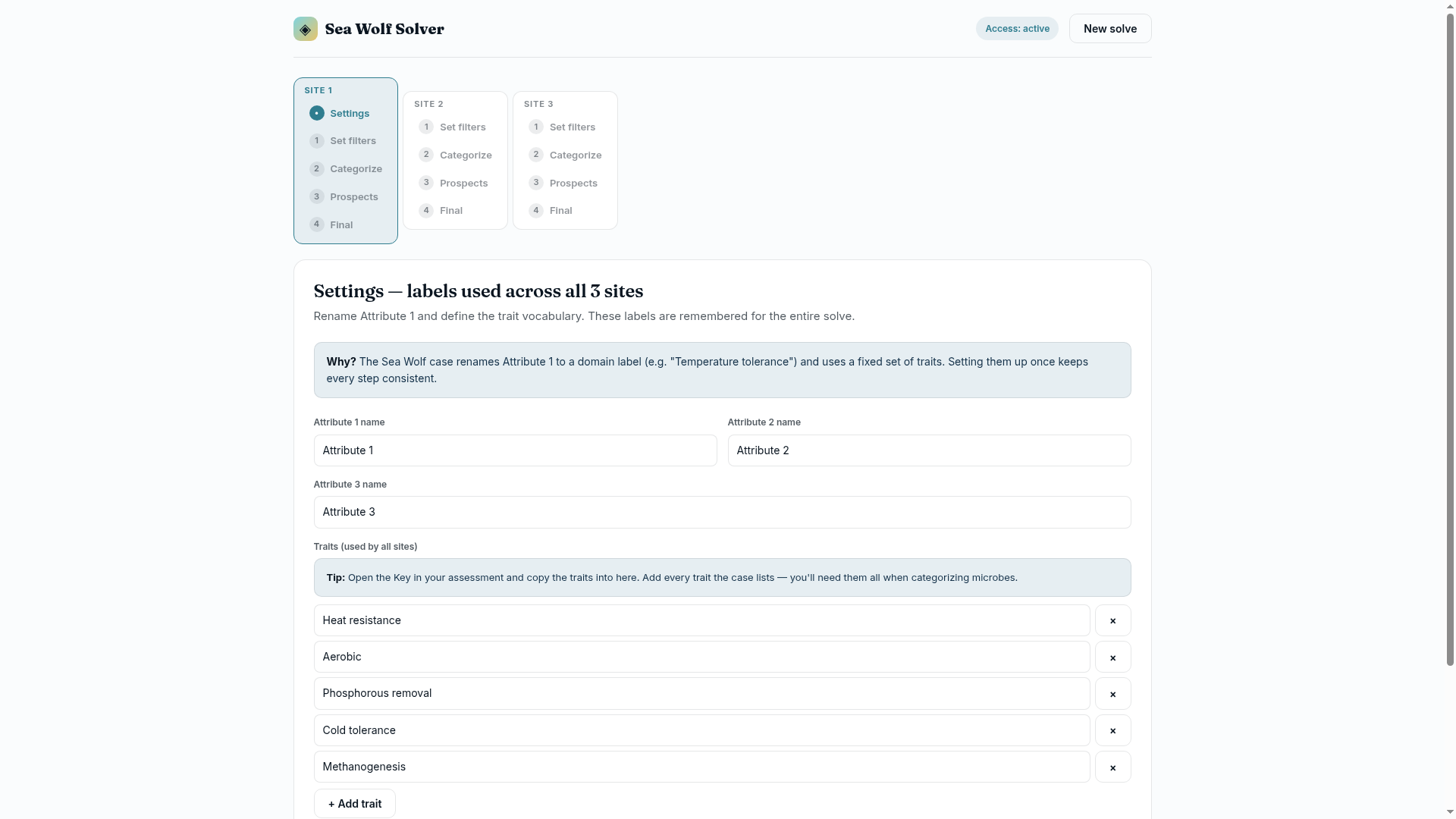
What the data looks like
A site might look like:
| Attribute | Range |
|---|---|
| Attribute 1 | 6 – 8 |
| Attribute 2 | 7 – 9 |
| Attribute 3 | 3 – 5 |
Plus a desirable trait (e.g. Heat resistance) and an undesirable trait (e.g. Aerobic).
Step 1 — Set Filters
The solver tells you to select the attribute whose range is farthest from the mean (5) and to choose the desirable trait as your filter. This narrows the candidate pool to microbes that are at least promising on the most discriminating dimension.
Step 2 — Species Categorization
You're presented with 10 microbes, one at a time. For each, you decide whether to:
- Move to Site 1 (the current site),
- Move to Site 2, or
- Remove (return) it.
You're also given a Site 2 attribute insight (e.g. "Attribute 1: 2–4") that you enter into the tool.
The scoring rule
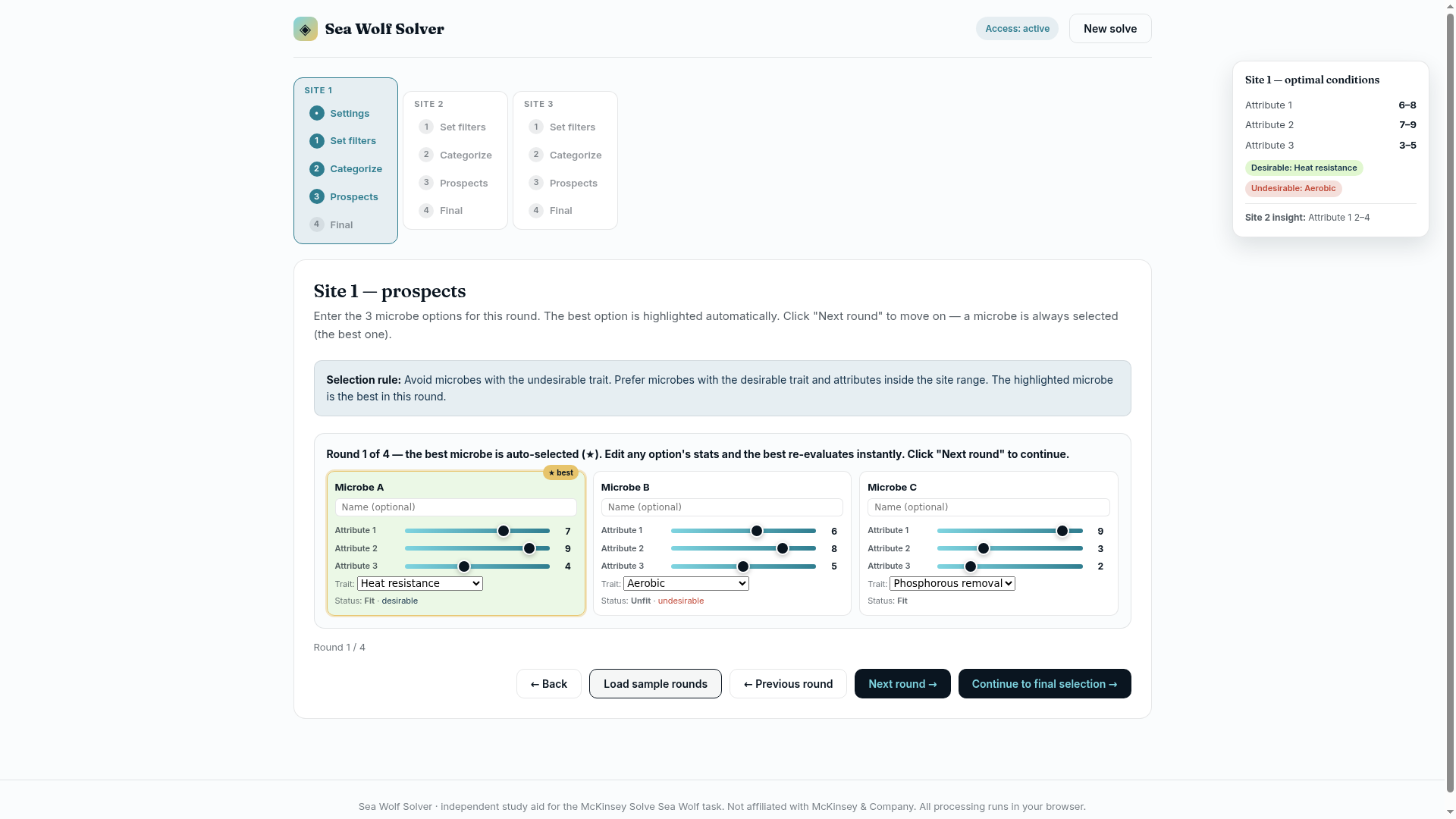
For each microbe, count how many of its attributes fall within the site's ranges, plus whether it has the desirable trait. Maximum score is 4 (3 attributes + 1 trait). Rules:
- Score ≥ 2 matching attributes/traits and no undesirable trait → move to Site 1.
- Has the undesirable trait (even with multiple matching attributes) → consider for Site 2 or remove.
- For Site 2: the microbe must have at least one attribute within the Site 2 insight range; otherwise remove it.
- Otherwise → remove.
Example B (→ Site 2): Attribute 1 = 1, Attribute 2 = 10, Attribute 3 = 2, trait = Aerobic (undesirable). Undesirable trait present → consider Site 2. If the Site 2 insight is "Attribute 1: 2–4", this microbe (Attribute 1 = 1) is outside that range → remove. (If it were inside, it would go to Site 2.)
Example C (→ Remove): Attribute 1 = 9, Attribute 2 = 3, Attribute 3 = 1, trait = Phosphorous removal (no match). Score 0/4 → remove.
Step 3 — Prospect Building
You're presented with 3 microbes at a time across 4 selection rounds. From each round you pick one microbe to add to a candidate pool. There are already 6 microbes in the pool from Step 2; you add 4 more for a total of 10. Use the same scoring rule: microbes with the undesirable trait should not be selected; prefer microbes with high match scores.
Step 4 — Final Selection
Pick 3 microbes from the pool of 10. This is the scored step. The selection is valid if and only if:
- The average of each attribute across the 3 chosen microbes falls within the site's range for that attribute.
- The undesirable trait is completely absent from all 3 microbes.
- The desirable trait is present in at least one of the 3 microbes.
Repeating for Sites 2 & 3
The whole four-step flow repeats for Site 2 and Site 3. The only change: from Site 2 onwards there's no Site 3 insight in Step 2 — microbes are either selected for the current site or removed.
This repetition is where timed practice matters. The Sea Wolf Simulation Redrock Simulation Sustainable Futures Lab mirrors the full 3-site flow so you can practise maintaining the same routing discipline after fatigue sets in. See the Sea Wolf simulation guide for a run-by-run review plan.
How you're scored
- Final selection validity — did the trio satisfy all three constraints?
- Categorization accuracy — were microbes routed correctly in Step 2?
- Prospect quality — were good microbes added to the pool in Step 3?
- Move efficiency — time and decision quality across steps.
Practice with the Sea Wolf Solver and simulation
Use the solver for exact decisions and the simulation for realistic timed practice across three sites.